Latest Headlines

US pitches ‘critical minerals club’ to counter ‘predatory’ trade practices
International
US pitches ‘critical minerals club’ to counter ‘predatory’ trade practices
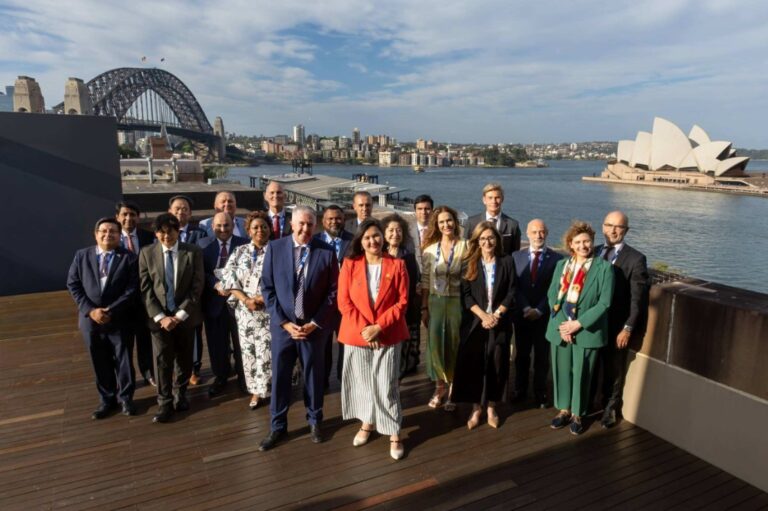
US pitches ‘critical minerals club’ to counter ‘predatory’ trade practices The US signed eleven new bilateral critical minerals frameworks with allies as part of its efforts to shift China’s dominance over the global industry.The frameworks were signed this week at the US’ first critical minerals ministerial event, hosted by the US State Department in Washington, which was attended by 54 countries and the European Commission.Though speakers did not refer to China specifically, it was clear that discussions centered around access and availability within the mining and processing sectors of critical minerals, industries that are largely influenced by the political whims of China.In 2025, China’s introduction of export bans and restrictions on rare earths and critical minerals triggered a series of back-and-forth trade manoeuvres from the US, exposing the vulnerability of the global supply chain and the urgency at which nations need to diversify.At a Centre for Strategic and International Studies (CSIS) event held on February 3, US Interior Secretary Doug Burgum said the US is typically a free market country.“We don’t like messing with markets, but if you have someone who’s dominant who can flood a market with a particular material, they have the ability to essentially destroy the economic value of a company or a country’s production,” he said.“Within this club of nations there would be a price floor, so people would know that with those price floors we can attract long-term capital.“The private sector can get involved and make investments in mining and refining, knowing that there’s going to be a market and they don’t have to worry about the bottom falling out because of predatory trade practices.”During opening remarks at the ministerial, US Vice President JD Vance said foreign supply of critical minerals floods markets and causes prices to collapse.“The result is a global market where consistent investment is nearly impossible, and it will stay that way so long as prices are erratic and unpredictable,” he said.“We all face the same vulnerability — access to the things that protect our people and sustain our way of life… the fundamental supply chains that support these industries sometimes can vanish in the blink of an eye without any control or influence from many of the countries in this room.”According to the Office of the US Trade Representative, the European Union, Japan and Mexico have also agreed to consider new policies such as price floors, coordinated stockpiling and shared regulatory standards to solve critical minerals supply chain vulnerabilities with the US.In the past five month, the US has also signed ten other critical mineral frameworks or memorandum of understandings (MoU) — including the $13b deal signed with Australia — and reached completion of negotiations on such agreements with seventeen other countries.US Secretary of State Marco Rubio said diversity and choice will only come if it is broadly adopted across multiple countries.“This must be an international, global initiative with like-minded countries who all have one thing in common,” he said.“We want to see a diverse across the world, so all of our economies can prosper without ever having these things, at worst-case scenario, being used as leverage against us or any other disruption that could come to the market that would undermine our collective economic security.”Federal Resources Minister Madeleine King represented Australia at the US-led critical minerals dialogue of ministers.During the event, Minister King launched the new Australian Critical Minerals Prospectus, which highlights 49 mines and 29 midstream critical minerals processing projects ready for investment across Australia, supporting the Australia-US critical minerals and rare earths framework.
300 jobs on the line at Australia’s largest power station
People & Workforce
300 jobs on the line at Australia’s largest power station
300 jobs on the line at Australia’s largest power station Negotiations between Origin Energy and Centennial Coal over a coal supply contract for the Myuna mine in NSW have stalled after Origin put forward a short-term proposal that fails to secure the future of the mine or its workforce.The dispute comes after Origin announced it would extend the life of Eraring power station until at least 2029 to support the electricity grid as the station moves towards retirement.Origin Energy proposed a new 12 month extension of the mines operations, maintaining their current agreements, which Centennial rejected on the grounds of being commercially unviable.The mine employs about 300 direct staff, along with hundreds more across the supply chain in Lake Macquarie and the Hunter region.Myuna Colliery was built solely to supply coal to Origin’s Eraring power station and without a viable contract, faces an uncertain future.Federal Member for Hunter Dan Repacholi says Myuna was built to supply Eraring and there is no alternative market.“Origin’s offer yesterday was disgraceful,” he said.“It was spin, not a solution.  A short-term, take-it-or-leave-it proposal that provides no certainty for workers, their families or the local community is not good enough.“If Origin walks away, this mine closes and that is a deliberate commercial choice, not an unavoidable part of the energy transition.”Community anger and concern continue to grow, with strong local campaigns backed by unions pushing for Origin to take responsibility for the future of the mine and its workers.Origin energy supply and operations head Greg Jarvis says the offer provides Centennial time to implement employee support initiatives as part of the Energy Industry Jobs Plan that the Net Zero Economy Authority is currently finalising, along with other state and federal government support.“Eraring plays an important role in keeping the lights on for NSW households and businesses, and we are committed to operating it reliably through to its scheduled closure in April 2029,” he said.“However, it is extremely disappointing to see workforce related issues being brought into our commercial negotiations with Centennial. We remain of the view that Centennial’s focus should be on helping its workers prepare for their futures through the energy transition.“We’ve stepped up and demonstrated how we’re supporting our people as we approach Eraring’s retirement, and we now need Centennial to come to the table and confirm its support for its workforce through this transition period.“We believe workers and the community deserve greater transparency from Centennial Coal on how it will support them through the full implementation of the Energy Industry Jobs Plan, if the Net Zero Economy Authority recommends it be required.”
WA vanadium miners get royalty relief
Economics & Commodity Prices
WA vanadium miners get royalty relief
WA vanadium miners get royalty relief Vanadium miners will be afforded significant royalty relief with the WA Government capping royalties for vanadium products at 2.5%.The new rate will support vanadium developers in WA, which has some of the world’s best vanadium deposits, as well as the current royalty rate of zero for the midstream production of vanadium electrolyte for the manufacturing of vanadium batteries.The policy is consistent with the government’s plans to install Australia’s first locally built utility-scale vanadium battery in Kalgoorlie.Vanadium battery technology will assist long-duration energy storage in WA as coal-fired power stations are retired and the share of renewables significantly increases in the State’s main energy grid.The 50-megawatt, 10-hour WA-made vanadium flow battery in Kalgoorlie will create 150 jobs during construction and be operational by 2029.CME chief executive Aaron Morey says reduced vanadium royalty rates — a 2025 election commitment — would support the production of a commodity that offered domestic value-adding potential.“Vanadium is an increasingly important input into battery technology and WA has some of the world’s largest known reserves,” he said.“Competitive royalty settings are vital to develop what is an emerging industry that offers an exciting opportunity for both upstream mining and the midstream processing of vanadium electrolyte.”The government will also work with the private sector to develop a local vanadium electrolyte production and battery assembly industry in Kalgoorlie to stimulate opportunities for downstream processing and exports.WA Mines and Petroleum Minister David Michael says this move will give industry players the financial confidence and certainty to make the significant investments required to see their projects come to fruition.“I am pleased to provide clarity around State Government royalties for Western Australia’s emerging vanadium miners and nascent vanadium battery industry,” he said.“This certainty is something the industry has requested and the Cook Government has agreed and delivered.”The WA Government has also doubled funding for the Exploration Incentive Scheme (EIS) to $18m.“The long-running EIS — now into its 33rd round — plays a critical role funding the discovery of new mineral deposits,” Mr Morey said.“Most exploration is undertaken by junior and mid-tier companies who have limited capital at their disposal but play an essential role maintaining WA’s pipeline of resources projects and the jobs they support.“The expansion of the EIS will allow more projects to access funding and help accelerate efforts to identify the mines of the future.”
Australia vies for global critical minerals investment
Politics & Regulation
Australia vies for global critical minerals investment
Australia vies for global critical minerals investment Federal Resources Minister Madeleine King has launched the new Australian Critical Minerals Prospectus as she gears up to hold talks with the US in Washington this week.The prospectus highlights 49 mines and 29 midstream critical minerals processing projects ready for investment across Australia to draw international interest — creating jobs and new supply chains of critical minerals with partner nations.Minister King will represent Australia at the US-led critical minerals dialogue of ministers — hosted by US Secretary of State Marco Rubio — and will take part in an industry forum as part of efforts to secure critical minerals supply chains.The meetings support implementation of the Australia-US critical minerals and rare earths framework signed by Prime Minister Anthony Albanese and US President Donald Trump in Washington last year.Minister King says the meetings will be a chance to discuss Australia’s $1.2b critical minerals strategic reserve and the Federal Government’s wider support for the critical minerals and rare earths sector.“Australia has a responsibility to lead on the supply of critical minerals and rare earths globally,” she said.“Australia has the deposits and the know-how to develop critical minerals projects reliably, sustainably and at scale.”Critical minerals and rare earths projects are located in every corner of Australia and are vital for the production of clean energy, as well as for the defence industry.Last month, the Federal Government announced the critical minerals strategic reserve would initially focus on gallium, antimony and rare earths elements, which are crucial for clean-energy and high-technology manufacturing as well as advanced military equipment.Federal Trade and Tourism Minister Don Farrel says the new prospectus showcases midstream processing opportunities to international investors, attracting the investment needed to build a future made in Australia and create more high paying, secure jobs for Australians“Australia’s abundant deposits of critical minerals, alongside the expertise to extract and process those minerals, presents an invaluable economic opportunity that the Government stands ready to seize,” he said.Earlier this week, the US also unveiled a $17.2b strategic critical minerals stockpile, dubbed “Project Vault”, with aims of reducing industry reliance on China and protect manufacturers from supply disruptions.Given its dominant role in global manufacturing and processing, China is positioned to influence global industries regardless of where the raw minerals or metals were originally mined.Against a backdrop of shifting domestic policy and rising geopolitical tensions, the US-led critical minerals dialogue of ministers — which is expected to commence today — could foster international framework partnerships that have the potential to reshape both regional and global economies.
Project Vault will be an independently governed public?private partnership that will store essential raw materials in facilities across the US.
International
Trump launches $17b critical minerals stockpile amid China risk
Trump launches $17b critical minerals stockpile amid China risk The US has unveiled a $17.2b (US$12b) strategic critical minerals stockpile, aiming to reduce industry reliance on China and protect manufacturers from supply disruptions.Dubbed “Project Vault”, the reserve will be backed by $2.8b (US$2b) in private sector financing and up to $14.3b (US$10b) from the US Export-Import Bank (EXIM).US President Donald Trump says the stockpile will ensure American businesses and workers are not harmed by shortage, as the US looks to avoid a repeat of last year’s Chinese export restrictions on rare earths.“Project Vault is designed to support domestic manufacturers from supply shocks, support US production and processing of critical raw materials, and strength America’s critical minerals sector,” EXIM chairman John Jovanovic said.EXIM says initial indications of participation from original equipment manufacturers include Clarios, GE Vernova, Western Digital and Boeing. Suppliers servicing Project Vault include Hartree Partners, Mercuria Americas, and Traxys.The announcement lands shortly after Australia confirmed its $1.2b Critical Minerals Strategic Reserve would initially focus on gallium, antimony and rare earths elements.Federal Resources Minister Madeleine King is now heading to Washington to hold talks with the Trump Administration, international partners and industry as Australia looks to strengthen cooperation on critical minerals and rare earths.Minister King will represent Australia at a US-led Critical Minerals Dialogue of ministers, hosted by US Secretary of State Marco Rubio, and will take part in an industry forum as part of efforts to secure critical minerals supply chains.Minister King says the meetings will be a chance to discuss Australia’s Critical Minerals Strategic Reserve and the Federal Government’s wider support for the critical minerals sector as both countries work to implement the Australia-US Critical Minerals and Rare Earths Framework signed last October.

The Australian Mining Review

Home and Editions

Mining news that matters

The Australian Mining Review delivers the stories that matter free, fast, and straight to your inbox. No paywalls, no barriers. Get unlimited access to every article, breaking news alerts and a free monthly newspaper delivered to your door.

Subscribe to The Australian Mining Review

Mining news, minus the paywall.

By subscribing to The Australian Mining Review, you agree to receive news updates and marketing communications from us.

Back to of the page